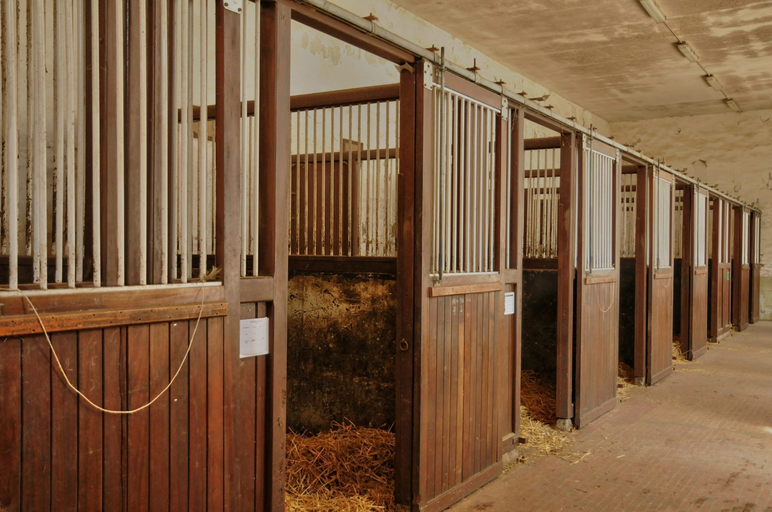
Do you want to renovate a smaller farm and are you thinking about which floor is best for a horse stable? You probably want to remediate the soil for the same reason as most small farmers: you no longer like the soil made of dirt, clay and sand. Then you probably know that it would be better to cover this floor with a covering that doesn't get dusty in the summer and can't be easily damaged by the horses when they get bored. However, there are several options and how should you choose the right one?
In our comparison of floors suitable for livestock, we look at several most commonly used options in different price ranges. We particularly take into account:
safety for health,
comfort for the animals,
ease of care,
possibility. driving around the barn with the tractor and other farm machinery.
You may end up lining the barn with one type of flooring and using a different type of flooring for the rest. That is of course also possible. It is often very difficult to decide which material is better overall.
Wood has always been with us
Does your barn have a wooden floor? Wooden floors used to be just as popular in horse stables as earth or clay. However, these were purchased by rich farmers, and the higher price is still a disadvantage today.
Safety for health: Wood is a natural material, so there is no danger here. However, pay attention to the composition of the top paints and substances used to stain the wood. These substances could be harmful to the health of the animals.
Comfort for the animals: Wooden floors are soft, so the horses can stand and lie very well on this floor. Of course, litter must also be used, but not in such a thick layer. No special insulation of the floor is necessary, wood itself has a heat-insulating effect.
Easy care: Unfortunately, care is not very easy. Wood doesn't like water, rotten spots and mold can develop. Dirt and leftover food remain in the gaps (e.g. between the boards), which attracts rodents. It also absorbs urine over time.
Agricultural machinery: So that the floor in the stable can withstand high loads, you must use hard wood (e.g. oak) and thick boards. Then there is no problem.
Today, wood is used for stables, for example in the form of wooden floors, wooden blocks or wooden tiles. This looks very nice, but because of the rot and the absorbed urine, these floors must be kept dry. And it's not that easy.
Concrete is probably the most common solution
If you've already done a survey about what type of flooring is most common in riding stables, you've probably come to the conclusion that the most commonly used material is concrete. Concrete pavers are sometimes used, but poured concrete floors are much more common. However, remember that this floor should never be smooth so that there is no risk of slipping. It is always good to create a pattern on the surface - it is enough to "sweep" the concrete with a broom before it hardens so that small grooves form in it. It is also recommended to water the floor with a slight slope to allow water to drain away.
Health safety: Concrete floors can be harmful to horse hooves. They are very hard, so pressure points and abrasions form very easily and the hooves become worn out. Rubber tiles used to line the boxes can help with this. You can also use rubber mats that are simply placed on the finished concrete base.
Comfort for the animals: As already mentioned, concrete is very hard. It also gets damp and cold, so expect a good layer of litter.
Easy care: A simple broom is enough. The only problem is the grooves. They make the floor non-slip, but absorb dirt and leftover food. In contrast to wooden floors, rodents cannot cause damage to concrete floors.
Agricultural machines: The load capacity is not a problem, concrete floors are designed for high loads. However, damage can occur due to drippingoil from agricultural machinery. These stains are not easily removed from concrete.
A reasonable compromise is to install a patterned concrete floor where horses move. The floor in the boxes can remain smooth, but cover it with rubber mats so that the floor is not so cold.
PVC tiles are a modern option
PVC tiles are relatively new, but thanks to their universal properties they are also used for floors in farms. They are soft, easy to care for and can withstand high loads. They are commonly used in garages, industrial companies and in the home, so why not in stables?
Health-safety: The PVC tiles terramondi are harmless to health, they do not contain any dangerous substances that could be released and harm the animals.
Comfort for the animals: The tiles have a heat-insulating effect and are therefore much more pleasant for horses than, for example, concrete. They already have a pattern, so the animals cannot slip.
Easy care: A broom is enough, and the floor should be washed every now and then with water and a cleaning agent. In contrast to concrete, oils and chemicals can also be easily washed off; compared to wood, the tiles do not absorb unpleasant odors.
Agricultural machines: The tiles are 7 - 8 mm thick and can withstand high loads and impacts. As already mentioned, they are non-slip, which makes vehicles easier to steer.
If you are not afraid of modern technologies, there is no reason not to choose PVC tiles. You will also be surprised by how easy it is to install and how long it lasts. Even after ten years, the floor looks the same, which definitely cannot be said about wood and concrete.
Can't decide? It's probably better to combine several options, as said at the beginning. How about concrete and then laying PVC tiles in the boxes? However, do not forget that, above all, horses need enough bedding, which cannot be replaced by any floor covering. This is soft and warm and also absorbs urine and feces. Don't just think about finances and your own benefit, every real farmer takes care of his animals with love, even if it is expensive.
Latest news
14.09.2026
Floor laying from terramondi – now with even more service & flexibility!